I don't know if I've mentioned this before but in my opinion that Shakespeare was a clever sod. Aggravatingly so if you happen to make your living writing plays. The exhibition at the British Museum only confirms this, and, in my opinion, pulls the rug from under any argument about how he must have been a courtier, a diplomat, a spy, a rich traveller, or even the Earl of Oxford. (For further evidence of the spurious nature of these claims and the near lunacy of some of their proponents you have to read Contesting Will by James Shapiro which is scholarly, readable, and a hoot, not an easy trick to pull off.)
The exhibition takes you through the sequence of the plays and puts them in the context of the events against which he was writing - which monarch was up to what, which latest unsuccessful Irish expedition had to be given a favourable spin - with portraits, artifacts, maps, reports from travellers, and contemporary accounts of everything from court intrigue to bear baiting and public executions.
The hard evidence of how Shakespeare came to write the plays is there in front of you. He did what all writers do. Kept his eyes and ears open and made it up. The infuriating thing is that he did slightly better than the rest of us, and that's why there's this ridiculous debate about his identity. Some people are unwilling to accept that a man we know virtually nothing about produced such a soaring and timeless body of work, in language that embraces all shades of humanity and speaks to anyone who listens. We can see how a man from a humble background could create Doll Tearsheet, and Falstaff, they say, but surely he lacked the background to chart Prince Hal's journey to Henry V? Well, he did. End of. Live with it.
I was working on an RSC project with a group of kids in Sandwell, on the edge of Birmingham. In the piece I was writing with them a girl is play fighting with two male friends and wants to tell them to get off, let go of her. I didn't feel familiar enough with the way Black Country kids speak so I asked the group of girls what they'd say and straight away one girl said 'Loose me.' Will would have been proud of her.
At the end of the exhibition there is a complete works covered by Diwali stickers that was passed around the prisoners under the eyes of the guards on Robbin Island who thought it was a bible. Each prisoner underlined the lines that meant the most to them and signed their names. It's open on the page where Nelson Mandela has underlined Caesar's speech to Calpernia as he is about to leave for the senate where he will be assassinated -
Cowards die many times before their deaths;
The valiant never taste of death but once.
Of all the wonders that I yet have heard,
It seems most strange that men should fear,
Seeing that death, a necessary end,
Will come when it will come.
A voice echoing from over four hundred years ago bringing strength, honesty and light into the darkness of a South African prison. Good one, Will.
Wednesday, 29 August 2012


Tuesday, 28 August 2012
I wake up dreaming pitches.
It's seven o'clock and I wake up. I've been dreaming, or thinking, I don't know which. A door slams. She's out of the house and in the fresh air, running along the path by the sea on the way to meet her friend. At two o'clock I hadn't dreamt or thought of her yet and when I woke up and small boy was playing with his grandfather by the sea, he wants to dig for treasure, the old man is remembering seeing bombers coming back over the coast. And when I woke up at four o'clock it was another idea only I can't remember what that one was.
Five stories stand alone stories. That's what I need. All linked together by a specific object in a specific place. Small cast for each one. The each one to be reduced to a few words, beginning, middle, and end. A pitch. Five pitches. So someone can tell us if we can go ahead or not.
The trouble is the only way I know how to find out what a story or a play is about, is to write it. All of it. Which is fine if you already have the commission, but I don't yet, and I haven't got the time to write five stories. Frankly, it's tying me up in knots.
I've tried displacement activities. I've done housework. Cut the hedges. Gone for walks. Ridden my bike. Played Spider Solitaire. Stared at the computer screen. Written early morning blogs.
I have three stories. I think they'll work. I've written them up. I need two more. I have one half good idea, and two not so good idea, and the two that have come up out of my dreams last night.
There's only one hope. I have a deadline for getting them in. I'll have to do what freelancers always do. Absolutely nothing. I'll wait until the last possible moment, probably on the day I have to send them in, and just sit down and write the buggers.
There. Sorted.
Five stories stand alone stories. That's what I need. All linked together by a specific object in a specific place. Small cast for each one. The each one to be reduced to a few words, beginning, middle, and end. A pitch. Five pitches. So someone can tell us if we can go ahead or not.
The trouble is the only way I know how to find out what a story or a play is about, is to write it. All of it. Which is fine if you already have the commission, but I don't yet, and I haven't got the time to write five stories. Frankly, it's tying me up in knots.
I've tried displacement activities. I've done housework. Cut the hedges. Gone for walks. Ridden my bike. Played Spider Solitaire. Stared at the computer screen. Written early morning blogs.
I have three stories. I think they'll work. I've written them up. I need two more. I have one half good idea, and two not so good idea, and the two that have come up out of my dreams last night.
There's only one hope. I have a deadline for getting them in. I'll have to do what freelancers always do. Absolutely nothing. I'll wait until the last possible moment, probably on the day I have to send them in, and just sit down and write the buggers.
There. Sorted.
Tuesday, 12 June 2012
Reading Kent Haruf.
I ran out of something to read in Savannah. I found a proper bookshop, and with no time to browse asked them to recommend an American writer I might not have heard of and they pointed me towards Plainsong by Kent Haruf.
Haruf's novels are set in Holt, a small town in Holt County, Colorado. Each one - The Ties That Bind, Where You Once Belonged, Plainsong and Eventide - is a small jewel. They explore in effortless prose the lives of the inhabitants if Holt. Sometimes the characters overlap from novel to novel, sometimes they don't, but the background of Holt remains constant.
He writes with precision and detachment. He might keep his distance as a writer but these books aren't cold. You always know where you are. The country, the houses, the bars might be sparely described but always with one or two images that feed your imagination and tell you all you need to know. You understand and empathise with what the characters are going through, what they're feeling, often by what they don't say or do. His people are flawed, see themselves as failures, don't understand why others find them deserving respect, affection, and love. And he writes killer opening sentences -
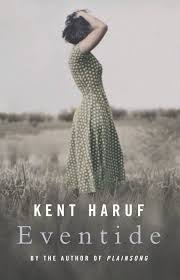
'They came up from the horse barn in the slanted light of early morning' Eventide.
'Here was this man Tom Guthrie in Holt standing at the back window in the kitchen of his house smoking cigarettes and looking out over the back lot where the sun was just coming up.' Plainsong.
Like many artists and writers who know the benefits of restricting themselves to a limited palate Haruf pushes through those limitations to take us deep into the human experience. These books aren't cosy. Don't be put off by the quote from the Mail on Sunday that describes them as a rural soap opera written by a poet they are much more. With wit, humour, brilliant dialogue, and wonderful prose he shows us what we are and makes us wish for what we might be.
Haruf's novels are set in Holt, a small town in Holt County, Colorado. Each one - The Ties That Bind, Where You Once Belonged, Plainsong and Eventide - is a small jewel. They explore in effortless prose the lives of the inhabitants if Holt. Sometimes the characters overlap from novel to novel, sometimes they don't, but the background of Holt remains constant.
He writes with precision and detachment. He might keep his distance as a writer but these books aren't cold. You always know where you are. The country, the houses, the bars might be sparely described but always with one or two images that feed your imagination and tell you all you need to know. You understand and empathise with what the characters are going through, what they're feeling, often by what they don't say or do. His people are flawed, see themselves as failures, don't understand why others find them deserving respect, affection, and love. And he writes killer opening sentences -
'They came up from the horse barn in the slanted light of early morning' Eventide.
'Here was this man Tom Guthrie in Holt standing at the back window in the kitchen of his house smoking cigarettes and looking out over the back lot where the sun was just coming up.' Plainsong.
Like many artists and writers who know the benefits of restricting themselves to a limited palate Haruf pushes through those limitations to take us deep into the human experience. These books aren't cosy. Don't be put off by the quote from the Mail on Sunday that describes them as a rural soap opera written by a poet they are much more. With wit, humour, brilliant dialogue, and wonderful prose he shows us what we are and makes us wish for what we might be.
Friday, 8 June 2012
The Isango Ensemble - Stephen Lowe's Ragged Trousers at the Hackney Empire
Last Sunday I went to Hackney Empire in the rain to see the Isango Ensemble in Stephen Lowe's Adaptation to The Ragged Trousered Philanthropists and I've been wondering since then what it is that makes that company so good?
Stephen Lowe has reworked his original adaptation. It's now about a group of South African workers building a new cinema for their white boss during the apartheid era. In the first half we see them at work and in the second, darker half they have to perform a concert for the whites.

Okay. What's so special? They can sing, dance, move, act amazingly. Every harmony is pitch perfect. Every routine has been worked on with a rigour and discipline that gives them real freedom. The whole company can turn on a sixpence. They are a true ensemble.
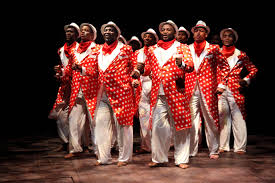
They have passion. They have belief. They are self aware, self depreciating, witty. They burst with confidence. There are no weak links, no small parts, no small performances. And they have Pauline Malefane whose voice is a wonder.

Okay. Apart from Ms Malefane there are other companies that possess similar qualities, indeed they are the qualities that all good companies aspire to. So? I've thought about this and I think it's the energy. They can go from 0-60 in an instant. I haven't seen that. Stillness, then, bang, high energy and never for a moment does it get ragged or lose focus or freshness. As simple and as hard as that. They are truly something to be seen.
And, a special plea, whoever has removed from Youtube the clip of Pauline Malefane singing Summertime with Simon Rattle and the Berlin Philharmonic please put it back. In my opinion not to make it publicly available is pretty close to a criminal act.
Stephen Lowe has reworked his original adaptation. It's now about a group of South African workers building a new cinema for their white boss during the apartheid era. In the first half we see them at work and in the second, darker half they have to perform a concert for the whites.
Okay. What's so special? They can sing, dance, move, act amazingly. Every harmony is pitch perfect. Every routine has been worked on with a rigour and discipline that gives them real freedom. The whole company can turn on a sixpence. They are a true ensemble.
They have passion. They have belief. They are self aware, self depreciating, witty. They burst with confidence. There are no weak links, no small parts, no small performances. And they have Pauline Malefane whose voice is a wonder.
Okay. Apart from Ms Malefane there are other companies that possess similar qualities, indeed they are the qualities that all good companies aspire to. So? I've thought about this and I think it's the energy. They can go from 0-60 in an instant. I haven't seen that. Stillness, then, bang, high energy and never for a moment does it get ragged or lose focus or freshness. As simple and as hard as that. They are truly something to be seen.
And, a special plea, whoever has removed from Youtube the clip of Pauline Malefane singing Summertime with Simon Rattle and the Berlin Philharmonic please put it back. In my opinion not to make it publicly available is pretty close to a criminal act.
Tuesday, 29 May 2012
Mississippi, the Blues, and the great Sonny Boy Williamson.

I can confidently assert that the Mississippi Delta does indeed shine like a National guitar, at least it did the first time I saw it about a month ago. We were travelling down through Virginia to Nashville, Memphis, and Clarksdale to New Orleans.

I was about twelve years old when I first became aware of the blues. I heard the Stones, the Beatles, the Manfreds, the Nashville Teens playing RnB. I remember the excitement in my best friend's voice when he told me on our way to school how he's heard someone called Wilson Pickett singing In the Midnight Hour when he was listening to Radio Luxembourg in bed the previous evening. This music was new. We'd never heard anything like it. We sought it out. We ate it up.
In Croydon there was a two storey shop, downstairs it sold Singer sewing machines and upstairs, I don't know why or how, was rack after rack of Chess records. We'd spend hours after school looking at them. Reading the labels. Wondering at the names we'd never heard of. Memorising the sleeve notes on the LPs. Hardly ever having the money to actually buy anything. And then I did have the money, enough for one single. I don't know why I picked it, I hadn't heard it before, didn't know the name on the yellow, red and black Chess label. I asked them to play it. Help Me by Sonny Boy Williamson, B side Bye Bye Bird. I still think it is one of the most exciting pieces of music I've ever heard. I saw Sonny Boy at the Fairfield Halls and last month I visited his birthplace in Glendora, Mississippi. On the way we stopped for petrol in Tuttwiller, where he's buried, and the girl behind the desk asked me why I'd come to Mississippi and I said I grew up with the music, but it was more than that. I am in debt to the music and the musicians.
The first time I heard Bessie Smith sing 'I'm sitting in the house with everything on my mind' her voice went right to the centre of my fears. The blues is fun, sexy, raucous, prophetic, poetic and profound. And all within an art form of deceptive simplicity.
John Lee Hooker, Muddy Waters, Wille Dixon, Chuck Berry and Howlin Wolf were the voices I listened to as I grew up. They talked to me about a world that frightened and attracted me. I had nothing in common with their life experience but that didn't matter because even if I didn't know anything about Parchman Farm and wondered if a jelly roll was some kind of cake, when they sung about the loneliness and the joy of being alive they were showing me something far more important than my common or garden teenage angst. And their work and their music has been a constant throughout my life. I reach for it in moments of celebration and despair. I'm still following their signposts. Hanging on to their hope. Revelling in the nights when the only thing that'll touch it is one bourbon, one scotch and one beer.


There's a museum there now commemorating the terrible murder of Emmett Till and a Blues Trail marker for Sonny Boy Williamson. I have no idea how such a place with such suffering and hardship produced a music that lights up the world. I suppose I went there to say thank you.
Friday, 25 May 2012
Happy Birthday, Sir Arnold Wesker.
Yesterday I celebrated your birthday at lunchtime by going to a rehearsed reading of I'm Talking About Jerusalem and in the evening I saw the same cast in Roots at Nottingham Playhouse. And both plays are alive and well and kicking. And full of passion and doubt. The characters may be floundering around, they may not understand each other, but they never lose their humanity. Watching Ronnie and Beatie and Dave and Ada was as powerful for me yesterday as when I first met them in my teens in between the green and yellow banded covers of the Penguin Wesker Trilogy O level text. I'm still floundering like Ronnie and I'm still looking for my voice like Beatie, I'm getting on with the day to day and doing my best, but like Dave and Ada I'd give the world if my little shovel could help build a new Jerusalem.
When they did Chicken Soup at Nottingham I was in the unlikely position of sharing a platform with you and the other writers for the season's launch. You spoke with insight and generosity and read one of the Mother plays and I felt proud to be sitting next to you. You signed my copy of Love Letters on Blue Paper. You wrote a small inscription and signed your name Arnold and went to pass the book back to me, stopped, looked at what you wrote and then wrote Arnold Wesker at the top of the page, to make clear it was you.
It must be frustrating to have had so many premieres outside the UK and so much neglect at home. You'd have enjoyed yesterday in Nottingham though. You had a cast and a director who understood what they were doing, what you wanted, and an audience who responded enthusiastically to the demands you made.. But I bet you'd have said don't you think it's about time someone had a look at all my other plays nobody in this country has had a chance to see? It is. Starting with The Merchant. (Your book The Birth of Shylock and the Death of Zero Mostel would make a bloody good radio play if anybody's listening.)
I felt refreshed yesterday. Relieved that the passion I recognised in your characters at fifteen is still there in me. And, okay, writing this is a displacement activity, but, I know what I want to do, what I'm meant to do, like you, sadly with only a fraction of your talent, I'm going to keep on working, keep waving my tiny tattered flag. Right now. As soon as I've finished this. And made another coffee. And possibly rearranged my bookshelves.
Happy BIrthday.
When they did Chicken Soup at Nottingham I was in the unlikely position of sharing a platform with you and the other writers for the season's launch. You spoke with insight and generosity and read one of the Mother plays and I felt proud to be sitting next to you. You signed my copy of Love Letters on Blue Paper. You wrote a small inscription and signed your name Arnold and went to pass the book back to me, stopped, looked at what you wrote and then wrote Arnold Wesker at the top of the page, to make clear it was you.
It must be frustrating to have had so many premieres outside the UK and so much neglect at home. You'd have enjoyed yesterday in Nottingham though. You had a cast and a director who understood what they were doing, what you wanted, and an audience who responded enthusiastically to the demands you made.. But I bet you'd have said don't you think it's about time someone had a look at all my other plays nobody in this country has had a chance to see? It is. Starting with The Merchant. (Your book The Birth of Shylock and the Death of Zero Mostel would make a bloody good radio play if anybody's listening.)
I felt refreshed yesterday. Relieved that the passion I recognised in your characters at fifteen is still there in me. And, okay, writing this is a displacement activity, but, I know what I want to do, what I'm meant to do, like you, sadly with only a fraction of your talent, I'm going to keep on working, keep waving my tiny tattered flag. Right now. As soon as I've finished this. And made another coffee. And possibly rearranged my bookshelves.
Happy BIrthday.
Tuesday, 22 May 2012
King Lear and the Belarus Free Theatre.
It's not knowing the language. It's not knowing the cultural references. Which means you can't understand all the choices that have been made. Yes, that's Gloucester and Kent but why is Kent on a trolley as if he has no legs and Gloucester in a wheel chair. For all their status and power they are helpless, but is that all?
Lear is vital, muscular, brutal, a violent Ubu Roi driven mad by power and cruelty not age and dementia. Cordelia and her sisters demonstrate their love with incestuous embraces. France is a decrepit old man, his voice a high pitched whine, who seizes his chance to grasp some young flesh. The Fool bares his arse. Gloucester makes Edmund catch his piss in a pot. They inhabit a filthy, corrupt, absurd cruel world where there is no place for love and affection and we're not permitted a moment of sympathy until it is too late and Lear wheels in his beloved daughter to silence.
No last redeeming lines from Edgar to give us hope. Cordelia wakes, giving us a suggestion of what could be if lives had been lived with some humanity. Or perhaps I want to hope that the possibility exists.
I've read about the situation in Belarus. I can only guess from what personal experiences this production has been conceived. The images are with me from last week. I do know that Shakespeare is a clever bastard and the Belarus Free Theatre are the most exciting company I've seen in a long time.
Lear is vital, muscular, brutal, a violent Ubu Roi driven mad by power and cruelty not age and dementia. Cordelia and her sisters demonstrate their love with incestuous embraces. France is a decrepit old man, his voice a high pitched whine, who seizes his chance to grasp some young flesh. The Fool bares his arse. Gloucester makes Edmund catch his piss in a pot. They inhabit a filthy, corrupt, absurd cruel world where there is no place for love and affection and we're not permitted a moment of sympathy until it is too late and Lear wheels in his beloved daughter to silence.
No last redeeming lines from Edgar to give us hope. Cordelia wakes, giving us a suggestion of what could be if lives had been lived with some humanity. Or perhaps I want to hope that the possibility exists.
I've read about the situation in Belarus. I can only guess from what personal experiences this production has been conceived. The images are with me from last week. I do know that Shakespeare is a clever bastard and the Belarus Free Theatre are the most exciting company I've seen in a long time.
Subscribe to:
Posts (Atom)